Monday, 11 March 2013

DAB510-1- USERS- Multicultural Cooking School and Food Stall.


Why I Selected the Cooking School.


I selected the multicultural cooking school and food stall over the exercise station, because i believe that it offers more to the site and provides more opportunities in terms of attracting people into the space and activating the parkland. 

The multicultural aspect of the design was also a key factor. This will encourage a wider audience to take part in the classes and assist in increasing community engagement. The node will provide a great opportunity for various members of the community to come together and share their different cultural backgrounds and traditions with one another. 


In terms of architecturally enhancing the space, i believe that the cooking school will be more of an addition to the space than an exercise station. It is also easier to determine the manner in which the node will be used as it will always have an "owner" present within it, whether it be the cooking instructor or the chef who is operating the food stall. The option to purchase food from the node, invites people to linger within the site and this will help to activate the space and encourage more people to visit it. 


Map showing the density of potential users in close proximity to the site.
RED= HIGH DENSITY
YELLOW= MEDIUM DENSITY
BLUE= LOW DENSITY

As shown above, there is also a large number of potential users, in close proximity to the site. The CBD is full of office workers who may visit the stall on their lunch breaks, while New Farm, may offer a large client base for the cooking school. 


Refining the Idea.


Now that an activity has been selected, certain key aspects and details need to be refined before any design work proper can begin. 


Spider diagram indicating key aspects of the Interaction Node. 
Many key features are highlighted in the image above and each one is explored and explained below. 


1) The multicultural aspect of the node.

  • This is a key feature of the node and will greatly impact its effectiveness.
  • The node is intended to provide cooking classes of different genres to the general public. 
  • These genres will vary on a daily or weekly basis and for that time, the food stall will be selling food items specific to that cuisine. 
  • This will hopefully help to develop interest in the node and ensure that there is always something fresh and new for users to experience.
  • The shared owner nature of this may cause some problems in terms of the number of temporary owners that the node will have, however, each owner will need to accept terms and conditions of using the node and leave it in the same manner that they received it or they may be fined and banned from using the node. 
  • The multicultural aspect of the node will help to increase awareness of other cultures within Brisbane.


2) The food stall aspect.

  • When not being used as a cooking school, the node could possibly double as a small food stalls, offering specific food items from whatever cuisine is on show at the time. 
  • This will attract a larger audience to the space and will provide a larger client base than cooking classes alone would.
  • The owner may choose to sell food prepared during classes, prepare fresh food on site or bring pre-prepared food with them to the node. 

Image sourced from: http://resources3.news.com.au/images/2011/09/22/1226143/431887-escape-food-stall.jpg

Something of a similar nature to the food stall above may provide a solution. 


3) The owner aspect. 


  • As mentioned before this is a complex aspect of the node. 
  • The nature of the concept requires a number of different owners to operate the node at different times. 
  • Strict guidelines and terms and conditions will need to be drawn up and the owners will need to agree to these.
  • One or more people may work within the node at any given time and operating hours will be determined by each owner, although it will be recommended that they open for lunch on weekdays as this is when there would be the largest pool of consumers. 


4) The visitor aspect. 

  • Visitors could take the form of either "students" attending cooking classes, or any member of the public visiting the food stall. 
  • Students will occupy the space temporarily and will require seating, shelter from the elements and a position from which to watch the cooking instructor. 
  • It has been decided that they will not each receive personal work stations, as the node cannot cater for this, and instead they will simply look on as the instructor talks them through the cooking process. 
  • Customers of the food stall may not occupy the node itself for as long, but may choose to linger in the surrounding parkland space while consuming the food that they have purchased. 
  • They may also chose to use the seating provided for the students.
  • It is hoped that the node will help to increase traffic through the site and create an interesting and vibrant environment. 
Image Sourced from: http://www.carlschaedel.com/art/cooking_class_comp.jpg 
A learning environment similar to the one pictured above would be desirable. 


5) The site aspect. 
  • In terms of the site, a number of factors need to be considered.
  • I believe that the proposed node will greatly enhance the space and help to increase interest of the site. 
  • The historical elements of the Wharves can be kept intact and will act as an informative tool and educate people on the history of Brisbane. 
  • The node itself has the potential to be a bright and vibrant addition to the parkland and will provide a focal point within it. 
  • The location of the node within the site will be a critical element and this will need to be explored further. 


6) The services aspect.

  • Services include basic amenities such as running water, electricity and gas. 
  • There is sufficient access to the site for deliveries and emergency vehicles. 
  • Ideally, the node would have the minimum amount of mechanical equipment and therefore, would require very little electricity. 
  • It may be possible to integrate solar panels into the design, and make the node somewhat self sufficient in terms of energy use. 
  • Gas and water lines should be present in the current structures and can simply be extended to the node as required. 


7) The flooding aspect.

  • This is a very notable design restriction and will greatly impact the final design of the node. 
  • It may influence choices in materials as well as what fixtures will be permanent within the node. 
  • mechanical equipment could be made mobile and removed in the case of a flood, while constructing the node out of metal and masonry may be more resilient than timber. 
  • Positioning the node critically within the site will also help to counteract the potential destruction of a flood. 

Minimum Requirements of the Cooking School. 

  1. One cooking station- stove, over, fridge. 
  2. Adequate working space for the instructor.
  3. Adequate seating for the students.
  4. Adequate shelter from the elements.
  5. Ability to lock up at night/when not in use. 
  6. Ability to enhance the site.
  7. Adequate counter space for the food stall.
  8. Adequate storage space.


Image Sourced From: http://newyork.grubstreet.com/upload/2010/12/end_of_the_year/20101220_yearendgrub-11food-trucks.jpg


The above image is a perfect example of how effective a small food stall that is selling an appetising and interesting product can be in a big city environment. The image shows a small kebab stall in New York City, one of the more common food stalls in the big apple and a very popular choice of snack of residents. 


DAB510-1-USERS- Who are they and What will they need?

Who are the Users and What do they Need?

MULTICULTURAL FOOD STALL AND COOKING SCHOOL. 


Owners of the node:
Cooking instructors and cooks-
Various cooks and instructors will own the node for a short period of time, it may vary daily, or on a weekly basis. Each one will provide a different cultural influence. 
- They will need cookers, work space, fridges, running water and electricity or gas. 
- Cooking utensils and ingredients. 
- They will use the node as a base from which to educate people on various cuisines and cultures. 
- They will also use the node as a food stall and sell food items when no classes are taking place. 


Visitors of the node:

Students-
This can be anyone who chooses to partake in a cooking class. 
- They will need seating, individual workstations or shared workstations. 
- Cooking utensils and ingredients. 
- They will use the node as an education tool learn about various exotic tastes and cuisines. 
- They will travel to the site, partake in the class and more than likely leave soon after. 


Visitors of the node:

Customers who are simply purchasing food- 
This could be anyone, although it will likely be people who work in the city or live in close proximity to the site. 
- Customers will need seating, shelter from elements and a reason to travel to the site. 
- They will more than likely travel to the node, purchase their food and linger for a while, as they consume it. 


EXERCISE STATION AND PERSONAL TRAINING CENTRE. 


Owners of the node:

Personal trainers-
Personal trainers wanting to use the space can hire it out on an hourly basis via the city council website. 
- They will require running water, a sheltered space and adequate structure and exercise devices to run an effective session. 
- Change rooms, or similar spaces may be desirable. 
- They will use the space for the time that they have booked it, and may make use of the surrounding parkland as well, both before, and after their sessions. 

Visitors of the node:

Students- 
These are people who have signed up for a personal training session.
- They will be under the instruction of the trainer and using the node in the manner that he directs them to. 
- They may require a supply of water, some shelter and possibly a changing room. 

Visitors of the node:

Passers by-
This applies to the general public, who are free to use the node at any time, as long as it is not previously hired out by a trainer. 
- They are free to occupy the space for as long as they like.
- They can use the node in whatever way they like.
- They may require a source of water and a changing room.
- These are predominantly predicted to be people who exercise along the riverside boardwalk or people occupying the parkland.  

DAB510-1- USERS- Possible Activities.

Possible Activities.

One integral aspect of the interaction node which needs to be defined before the potential users are explored and analysed, is the specific activity that the node will offer. The interaction node is required to provide an informal learning environment and supply the public with information, demonstrations and any other necessary means of translation of a specific activity, selected from a list of genres. 

The two more relate-able and logical genres for myself personally, were food and sports. I think something to do with both of these things would greatly enhance the space and there is a suitable client base for both activities within the close surroundings of the site. 
Some sort of cooking lessons or an interesting and unique food cart could attract a large number of people to the Wharves and help to create a vibrant and lively environment. While an exercise station located close to the river boardwalk, which is used heavily by runners and cyclists, could provide a great means of additional exercise to passers by. The station could be hired out by personal trainers, leading a group, or one on one session with a client, while the food cart could allow a variety of chefs to use it, each one specialising in something different. 

Each option is explored further and analysed below. 


OPTION 1: FOOD STALL AND COOKING LESSONS.


Summary: 


What is it?

- A multicultural cooking school and food stall. 

What services will it provide?

- The node will provide a variety of cooking classes, each offering a take on a different style of cuisine. 
- It will provide an opportunity to learn about different cultures, their traditions and of course the cooking styles. 

Who will be the users?
- The node will provide lessons to anyone who cares to sign up via the Brisbane City Council website. 
- When not offering classes, the node will double as a food stall, providing interesting and authentic, exotic cuisine to anyone who cares to venture to the Wharves. 
- Key users will include people who work in the city as well as people who live close to the site. 

How will it enhance the space?

- It is hoped that the node will increase the number of people who visit the wharves and help to create an active environment. 
- It will provide refreshments to people occupying the parkland that surrounds it.
- The node will be a great means of educating the greater public on the immense cultural diversity that exists within Brisbane and will also offer an opportunity for users to learn about the history of the Wharves and in turn, the history of Brisbane itself. 


Examples of existing food stalls are shown below. 


Image sourced from: http://farm1.static.flickr.com/13/90347343_eb9ba96e9f.jpg
This small food stall is a perfect example of how such an intervention can brighten up a space and create a point of interest within it. 
Image sourced from: http://upload.wikimedia.org/wikipedia/en/f/f2/Chedi_food_stall.jpg


The above image is a great example of how preparing food on site with minimal equipment is possible. 


Image sourced from: http://www.sixthseal.com/images/bcf2008/food%20stalls.jpg
 This is another example of how a small food stall can create a vibrant and interesting node within an urban environment.


Image sourced from: http://seasonsoffoodtravel.files.wordpress.com/2010/06/p3180487.jpg

Pros and Cons of a Multicultural food stall and cooking school: 

Potential Pros and Cons of a food stall and cooking school. 
As noted above there are a number of pros and cons which regard the cooking school and food stall. One key con of the concept it the necessity for mechanical equipment within the node, such as cookers, ovens and fridges. This could complicate construction, and could also prove to be a security hazard as they would need to be secured at night and when the node is not active. This equipment would also be a negative aspect of the node, if the site were to flood again, as they would most likely be damaged and need o be replaced. 

A major pro of the proposed node is the fact that it represents and would educate people on many of the various cultures that are present in Brisbane. Brisbane's ever growing immigrant population is something that everyone will need to learn to live with, and if everyone was aware of certain aspects of the culture of these immigrants, it will certainly make the adjustment easier. 

Coming from a very diverse cultural background myself, being of Indian descent, born and growing up in Zimbabwe and now living in Australia, and having been lucky enough to travel to various countries, i have experienced my fair share of cultural diversity. I believe that a food stall offering various cuisines would be a great addition to the site and would create a new attraction within the inner-city. 


OPTION 2: EXERCISE STATION AND PERSONAL TRAINING SESSIONS. 


Summary: 

What is it?

- A structure that combines a variety of bars, steps and ropes, that can be used for body weight exercises, such as pull-ups  under the instruction of a personal trainer, or by an individual. 

What services will it provide?

- The node will provide users of the Eagle street boardwalk with an opportunity to take part in a variety of strength exercises, rather than simply the cardiovascular exercise of running of cycling. 

Who will be the users?

- The node will be free to use and open to the public, unless previously booked by a personal trainer. 
- Key users will be office workers who exercise on their lunch breaks. 

How will it enhance the space?


- The structure will provide a point of interest within the site and along the riverside boardwalk. 
- The parkland around the node could also be used for various exercises, if the personal trainer were to chose to do so. 
- The node will draw more people into the space and hopefully reactivate the site. 


Examples of exercise stations are shown below:


Image sourced from: 
The above image demonstrates that a minimum amount of equipment is needed to run an effective personal training session. 


Image sourced from: http://imgc.classistatic.com/cps/blnc/121213/627r1/7670jhm_20.jpeg


The image above is an example of an existing exercise station which is fairly simple and makes the use of a simple combination of bars and ropes. 


Image sourced from: http://www.bodybenefit.com.au/images/other_pages/phil_and_brook_PT.jpg

This is another example of an existing exercise station, constructed from simple bars at different levels. 


Pros and Cons of a Exercise station and Personal Training Centre:

Pros and Cons of an Exercise station and PT centre.
As mentioned above, a major pro of the exercise station is that it would be very simple, easy to construct and have minimum mechanical parts. This would make it resilient in the case of a flood and easy to fabricate off site. The combination of various bars and ropes has the potential to create a very interesting structure and an iconic intervention within the site.
There is also a large client base within the area, with a large number of people using the riverside boardwalk to exercise, as well as a large residential area close to the site. The station could be used by office workers who exercise on their lunch breaks, the general public, or it could be hired out by a personal trainer, looking to run a group fitness session. 

A major con of such a node is that it may not be used as it is designed to be. a number of exercise stations have been placed in parks around Brisbane and very few are ever used. It could be argued that the large client base within close proximity to the site would make for a different outcome, but there is no guarantee to this. When not used by personal trainers, it is difficult to predict the manner in which the station may be used. 


SUMMARY: 

Both nodes have a lot to offer to the site, and would be effective in their own way. The food stall is assured to be used in the proposed manner, while the exercise station leaves a lot up to the intuition of the user. 

The cooking school could potentially sell the food prepared, to generate a profit that could help to sustain the node, or be donated to charity. Alternatively, the food could be supplied to a homeless shelter in the area. When not used for a class, the node could be operated by various users of different cultural backgrounds, each providing a different cuisine. Each day could be different, for example, Monday could be Thai, while Tuesday may be Lebanese. This would be very effective, and provide people in the area an opportunity to sample food items they may usually not have the chance too. 


Thursday, 7 March 2013

DAB510-1-SITE- A Closer Look at the Wharves.

A Closer Look at the Wharves. 

The Howard Smith Wharves have been investigated initially and somewhat superficially in the previous post, however, it is also important to view them from an architectural perspective and assess them in regards to potential opportunities and restrictions they may present. Key aspects such as the context, accessibility, nearby services, potential restrictions and potential opportunities are discussed and explained in this post. 


CONTEXT

The Howard Smith Wharves are located along the Brisbane river bank in the suburb of Fortitude Valley. They are located a short distance from the Central business district and can be accessed from nearly all directions and by various means of transport, both public and private. The area towards the West of the Wharves is dominated by residential buildings including houses and apartment buildings. Smaller commercial and retail buildings can be found within Fortitude Valley while larger, high rise office buildings and apartment blocks dominate the Eagle Street Waterfront and the CBD, to the East of the Wharves. This surrounding area is highly populated and used and as a result there are a lot of potential users in close proximity to the site. The riverfront walkway is often busy with people exercising and it is a popular route for runners, cyclists and walkers. 


Macro Scale View of the site- Image- Nearmap

Residential zone in yellow, Commercial/Mixed use high density area shown in blue. Image- Nearmap

ACCESS

Vehicular access to the site is granted via Boundary Street, a small service road that connects Ann Street and Ivory Street. Pedestrian access is currently prohibited, however, it can be assumed that the walkway that was damaged and destroyed during the 2011 floods, still exists, and runs along the waterfront. There are also pedestrian and bicycle paths that run along the top of the site, adjacent to Bowen Terrace and these grant access to the pedestrian paths atop the Story Bridge. There are also multiple public transport options within close proximity to the site, including buses, city cat services and a city cycle station. 

Vehicular access point to the site highlighted in red. Image- Nearmap


SERVICES

Due to the site's location and its close proximity to the CBD, it has easy access to a number of services. Although vehicular access to the site is somewhat restricted, it is still sufficient for emergency services, supply vehicles and other similar activities. There is also an abundance of public transport around the site, making access to it very easy and minimising the need to parking spaces on the site itself, although there is adequate space for this on the site. The spaces around the site such as the Eagle street boardwalk are often used as exercise paths and provide a vital function within the CBD. 


Various Transport. Citycat in red, major bus stops in yellow and train stations in green. 


RESTRICTIONS

One of the most important aspects to consider is the possibility of the site flooding, as it did in 2011. This should be considered during the design process and it may be favourable to construct the interaction node out of a durable material that won't be damaged if submerged. This is also worth considering when selecting an activity for the node. Another restriction, although not as obvious is access to the site. The service road provides vehicular access, although it may not be capable of sustaining a high amount of traffic. Pedestrian access is currently non existent, although it can be used that the Eagle Street boardwalk continues along the length of the site and this would provide adequate pedestrian access to space. 

The final restriction would have to be the existing structures and the manner in which they dominate the existing space.It is integral for the interaction node to communicate effectively with these structures as well as the greater site, and as the structures are heritage listed, any modifications to them, may not be possible. 


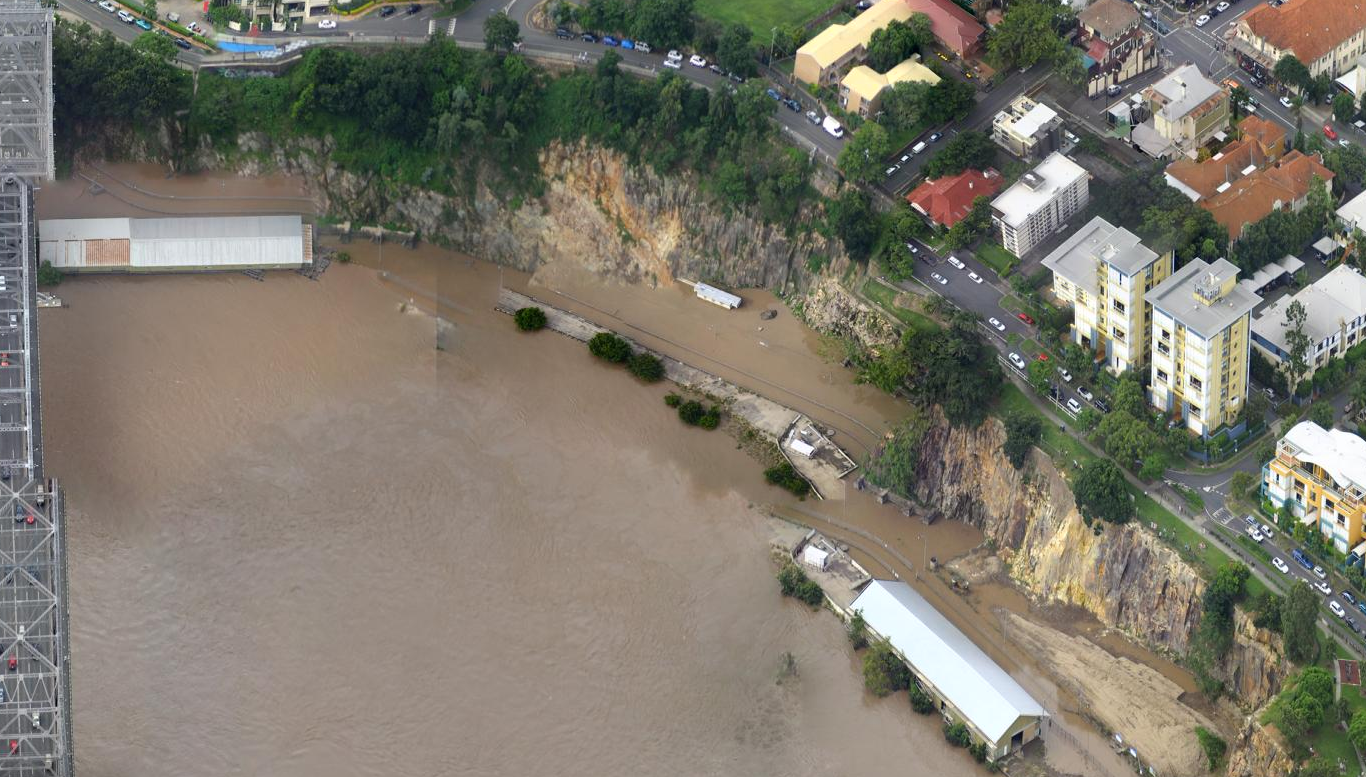
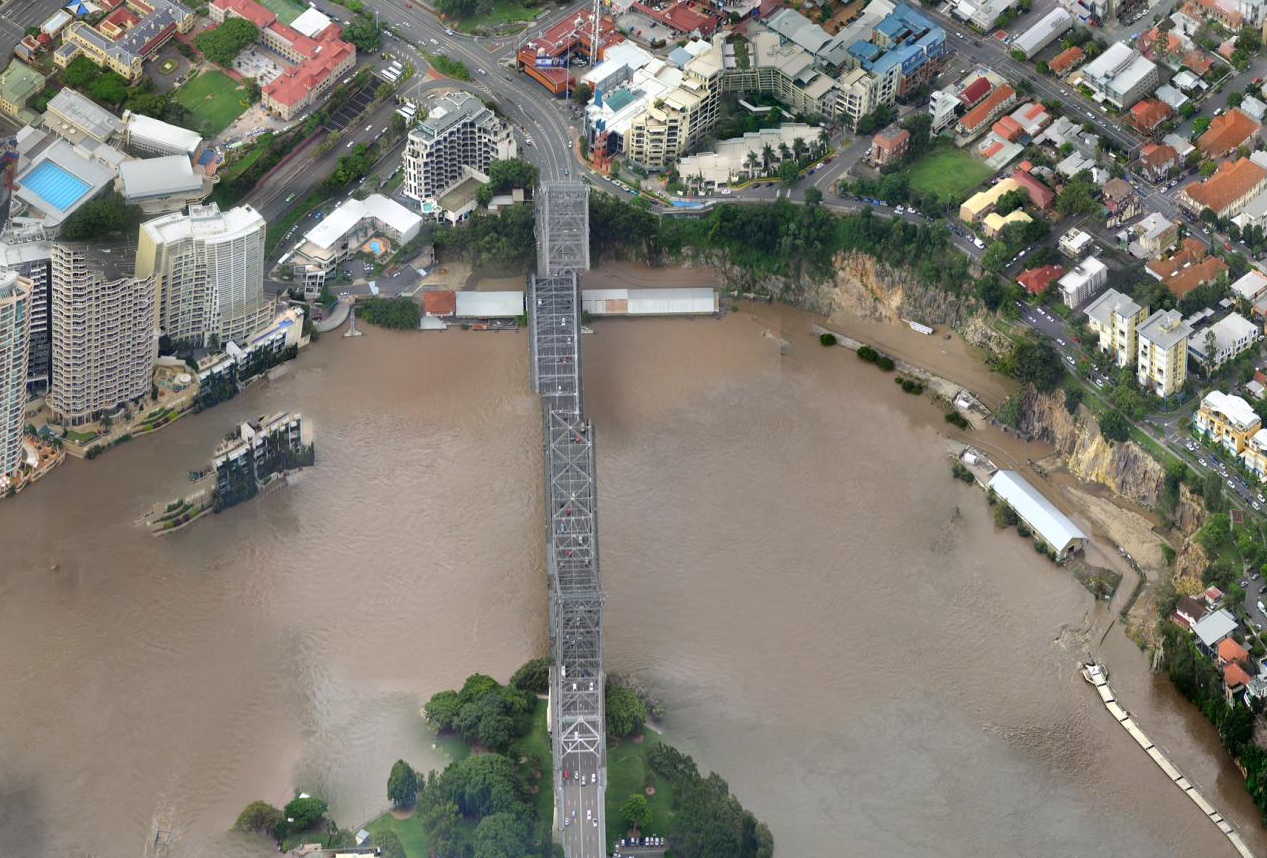
Various Images taken during the 2011 floods. Image- Nearmap


OPPORTUNITIES

The site as a whole provides a number of great opportunities to activate and bring attention to an unused and historical site within the inner city. The Wharves were an important site in the development of the city, and bringing attention to them and educating people about this could be seen as very desirable. Currently, the site is a very large block of unused space within the CBD which is not very common. Activating this space could provide the city with another vibrant attraction and assist in reinforcing Brisbane's claim to be a new world city. The size and location of the site are key factors in this and the abundance of potential users in close proximity to the site are another factor that can greatly contribute to the effectiveness of the interaction node.
Creating a link between existing green spaces could be vital to the development of the site. 


Various existing green park spaces. Image- Nearmap


POSSIBLE NODE LOCATIONS

The immense size of the site and relatively small size of the interaction node means that it can be placed nearly anywhere. However, depending on the chosen activity, some locations may be more effective than others. For example if the node is focused around exercising, a location close to the riverfront and the boardwalk may be desirable, while if it were something more unique and unspecific to anything within the site, it could be located along the cliff face, with a possible staircase proving easy access from above. A possible integration into the existing structures, may also provide an interesting and eye catching result. 


Potential locations for the interaction node. Image- Nearmap


Saturday, 2 March 2013

DAB510-1- SITE- Discovering Howard Smith Wharves


HOWARD SMITH WHARVES.

Originally constructed in conjunction with the Story Bridge, the Howard Smith Wharves were previously occupied by the Howard Smith Company from which they gained their name. Consisting of a number of storage sheds, the site has been vacant since the 1960's and is currently up for redevelopment. 


Video captured 05/03/13 while aboard a CityCat. 


Journey to the Site.


Upon travelling to the proposed site for the project, which is the Howard Smith Wharves, a number of elements within the urban fabric of the city caught my attention. I chose to travel to the site from QUT Gardens Point, taking a route through the botanical gardens and along the Brisbane river, past Eagle Street pier and Riverside Centre.

We also took a City Cat past the site, as this provided a different and key perspective and view of the area.

The first thing i noticed was the array of boat sheds and shelters along the opposite side of the river.


I found these structures to be particularly interesting because of the manner in which they extend out over the river and create an interesting relationship along the rivers edge. While providing shelter and a vantage point from which to view the city, i found some of these structures, although weather beaten and flood damaged to be very adapt to their location.


The second thing that caught my attention while travelling towards the site, was the relationship between the site at ground level, and the the Story Bridge high above it.


I found this relationship interesting because it created an interesting space and gave the site a unique character. Not only do the existing structures integrate well with the bridge support columns but they also give the site a historical feel and character.


The final notable moment along the journey to the site, was when we passed beneath the Story Bridge.


This was something i had never done before, and i had only ever come into close contact with the bridge while in a vehicle passing over it. I found the steel structure of the bridge to be very interesting and in particular the lattice of beams that form the underside of it.

It was also worth noting that on the way to the site, we happened to pass a fair number of people exercising along the river. Whether they were running, walking, or cycling, it became clear that this was a favourable route to take. 

The Site Itself.

Upon arriving at the site, my initial thought was regarding how large it was. Having never traversed through the area before and having only seen the site from a distance, i was taken aback by its size and the nature of the landscape that surrounds it. 


Access onto the site itself was restricted, so we were forced to make to with whatever vantage points we could find around it, so please excuse the fact that the majority of my photos only show parts of the site. 


The elongated and organic shape of the site was another aspect i found intriguing. The manner in which it engaged with the river bank, sometimes encroaching out over the river, was another interesting aspect, as are the steep cliffs that form the back of the site. I had not fully gained an appreciation of the height of these cliffs until visiting the site, as satellite images and contour maps simply do not convey the information effectively. 


I believe the Wharves are a site bursting with potential and that they would be a prime location for an interaction node such as is being proposed.


Surroundings of the Site. 

Bordered by steep cliffs and the river, the site is somewhat isolated from the rest of the city. However, there are both footpaths and roads that run along the top of the site and access is via a service road along the bottom left edge of the site. 


The site is surrounded by high rise commercial office buildings along the Eagle street stretch of the river and smaller apartment buildings and a more residential urban fabric atop the cliffs and towards New Farm. The pedestrian path that runs along the riverfront abruptly comes to an end at the Wharves as a portion of it was damaged and washed away during the devastating 2011 floods. However, this path is still heavily used by pedestrians and cyclists, and is a key facility for office workers wanting exercise during their lunch breaks. 

Other somewhat notable elements of the immediate surroundings of the site include a City Cycle rack, located just to the right of the Story Bridge, above the site as well as a small park which doubles as an excellent lookout. 


One particularly interesting element that was discovered were the two Lifeline phones, located on either side of the Story Bridge, above the Wharves. Positioned to attract the attention of would be suicide victims, i found these phones and the service they provide, attempting to talk would be suicide victims out of killing themselves, particularly unique and interesting. 


This could possibly hold some potential as a concept behind the interaction node, and providing counselling or a similar service could be something that may need to be looked into a bit further.